
Published: 2013-10-18 19:58:30

As the prime mover in the original Internet he's definitely IN...

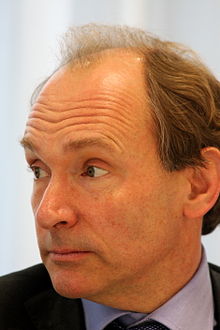
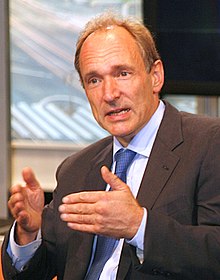
Sir Timothy John "Tim" Berners-Lee, OM, KBE, FRS, FREng, FRSA (born 8 June 1955), also known as "TimBL", is an English computer scientist, MIT professor and the inventor of the World Wide Web. He made a proposal for an information management system in March 1989 and on 25 December 1990, with the help of Robert Cailliau and a young student at CERN, he implemented the first successful communication between a Hypertext Transfer Protocol (HTTP) client and server via the Internet...

This is a new section...

After leaving CERN in 1980, he went to work at John Poole's Image Computer Systems, Ltd, in Bournemouth, England. The project he worked on was a real-time remote procedure call which gave him experience in computer networking. In 1984 he returned to CERN as a fellow.

In 2004, Berners-Lee was knighted by Queen Elizabeth II for his pioneering work. In April 2009, he was elected a foreign associate of the United States National Academy of Sciences.

My Take on The Web

Tim is a great man... I'd like to make a small fraction of the impact he has made by allowing people to accumulate and share their own Personal Web...

Berners-Lee is the director of the World Wide Web Consortium (W3C), which oversees the Web's continued development. He is also the founder of the World Wide Web Foundation, and is a senior researcher and holder of the Founders Chair at the MIT Computer Science and Artificial Intelligence Laboratory (CSAIL).[5] He is a director of the Web Science Research Initiative (WSRI),[6] and a member of the advisory board of the MIT Center for Collective Intelligence.[7][8]

In 1998 he was awarded with an honorary doctorate from the University of Essex.[47]

In 2001, he was elected a Fellow of the American Academy of Arts and Sciences.[50]

In 2002, he was named in the BBC's list of the 100 Greatest Britons following a UK-wide vote.[51]

The Hypertext Transfer Protocol (HTTP) is an application protocol for distributed, collaborative, hypermedia information systems.[1] HTTP is the foundation of data communication for the World Wide Web. Hypertext is a multi-linear set of objects, building a network by using logical links (the so called hyperlinks) between the nodes (e.g. text or words). HTTP is the protocol to exchange or transfer hypertext.

The standards development of HTTP was coordinated by the Internet Engineering Task Force (IETF) and the World Wide Web Consortium (W3C), culminating in the publication of a series of Requests for Comments (RFCs), most notably RFC 2616 (June 1999), which defines HTTP/1.1, the version of HTTP in common use.

Here are my views on Hypertext

It's cool.

Dudley Clarke (1899--1974) was an officer in the British Army, known as a pioneer of military deception operations during the Second World War. His ideas for combining fictional orders of battle, visual deception and double agents helped define Allied deception strategy during the war. Clarke trained with the Royal Flying Corps during the First World War, and then led a varied career doing intelligence work in the Middle East. In 1936 he was posted to Palestine, where he helped organise the British response to the 1936 Arab uprising. Early in the Second World War, Clarke proposed, and helped implement, an idea for commando raids into France. In 1940, he was placed in charge of strategic deception in Cairo, and was called to London in 1941 as his deception work had come to the attention of Allied high command. Throughout 1942 Clarke implemented Operation Cascade, an order of battle deception which added many fictional units to the Allied formations; by the end of the war the enemy accepted most of the formations as real. From 1942 to 1945, Clarke continued to organise deception in North Africa and southern Europe. He retired in 1947 and lived the rest of his life in relative obscurity. (Full article...)

My Take on The Web

July 30, 2013 11:12

Engineering is the application of scientific, economic, social, and practical knowledge in order to design, build, and maintain structures, machines, devices, systems, materials and processes. It may encompass using insights to conceive, model and scale an appropriate solution to a problem or objective. The discipline of engineering is extremely broad, and encompasses a range of more specialized fields of engineering, each with a more specific emphasis on particular areas of technology and types of application.

The World Wide Web (abbreviated as WWW or W3,[2] and commonly known as the Web) is a system of interlinked hypertext documents accessed via the Internet. With a web browser, one can view web pages that may contain text, images, videos, and other multimedia, and navigate between them via hyperlinks.

iRelate links the Web to your Personal Web...

Using a console that would combine the functionality of the Xerox, telephone, television and a small computer, allowing data transfer and video conferencing around the globe.

The National Academy of Sciences (NAS) is a corporation in the United States whose members serve pro bono as "advisers to the nation on science, engineering, and medicine." As a national academy, new members of the organization are elected annually by current members, based on their distinguished and continuing achievements in original research.

The National Academy of Sciences (NAS) is a non-profit organization in the United States whose members serve pro bono as "advisers to the nation on science, engineering, and medicine". As a national academy, new members of the organization are elected annually by current members, based on their distinguished and continuing achievements in original research.

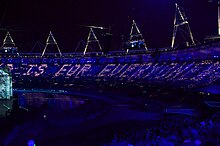
In 2004, Berners-Lee was knighted by Queen Elizabeth II for his pioneering work.[10] In April 2009, he was elected a foreign associate of the United States National Academy of Sciences.[11][12] He was honoured as the "Inventor of the World Wide Web" during the 2012 Summer Olympics opening ceremony, in which he appeared in person, working at a NeXT Computer at the London Olympic Stadium.[13] He tweeted "This is for everyone",[14] which was instantly spelled out in LCD lights attached to the chairs of the 80,000 people in the audience.[13]

Mid '80s "Director" Software from Tony Sukiennik was used on the periphery of this lab in Project Athena and the Media Lab at MIT...

MIT Computer Science and Artificial Intelligence Laboratory (also CSAIL) is a research laboratory at the Massachusetts Institute of Technology formed by the 2003 merger of the Laboratory for Computer Science and Artificial Intelligence Laboratory. Housed within the Stata Center, CSAIL is the largest on-campus laboratory as measured by research scope and membership.

The MIT Center for Collective Intelligence[1] (CCI) is a research center at the Massachusetts Institute of Technology, headed by Professor Thomas W. Malone that focuses on the study of collective intelligence.

The European Organization for Nuclear Research (French: Organisation européenne pour la recherche nucléaire), known as CERN ( /ˈsɜrn/; French pronunciation: [sɛʁn]; see History), is an international organization whose purpose is to operate the world's largest particle physics laboratory, which is situated in the northwest suburbs of Geneva on the Franco�Swiss border (46°14′3″N 6°3′19″E). Established in 1954, the organization has twenty European member states.

on 25 December 1990, collaborating with Tim Berners-Lee and a young student at CERN, he implemented the first successful communication between a Hypertext Transfer Protocol (HTTP) client and server via the Internet.

The Web through My Lens

Who was the young Student??

He is a public speaker on the past and future of the World Wide Web and delivered the keynote opening speech at the annual Runtime Revolution developer conference in Edinburgh, Scotland on 1 September 2009.