


Founded by Tim Berners-Lee at MIT and currently headed by him,[2] the consortium is made up of member organizations which maintain full-time staff for the purpose of working together in the development of standards for the World Wide Web. As of 29 March 2012, the World Wide Web Consortium (W3C) has 351 members.[1]
W3C also engages in education and outreach, develops software and serves as an open forum for discussion about the Web.


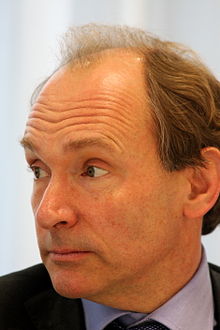
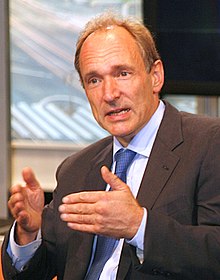
As the prime mover in the original Internet he's definitely IN...
Sir Timothy John "Tim" Berners-Lee, OM, KBE, FRS, FREng, FRSA (born 8 June 1955), also known as "TimBL", is an English computer scientist, MIT professor and the inventor of the World Wide Web. He made a proposal for an information management system in March 1989 and on 25 December 1990, with the help of Robert Cailliau and a young student at CERN, he implemented the first successful communication between a Hypertext Transfer Protocol (HTTP) client and server via the Internet.
This is a new section...
After leaving CERN in 1980, he went to work at John Poole's Image Computer Systems, Ltd, in Bournemouth, England. The project he worked on was a real-time remote procedure call which gave him experience in computer networking. In 1984 he returned to CERN as a fellow.
In 2004, Berners-Lee was knighted by Queen Elizabeth II for his pioneering work. In April 2009, he was elected a foreign associate of the United States National Academy of Sciences.
My Take on The Web
Tim is a great man... I'd like to make a small fraction of the impact he has made by allowing people to accumulate and share their own Personal Web...
In 2004, Berners-Lee was knighted by Queen Elizabeth II for his pioneering work.[10] In April 2009, he was elected a foreign associate of the United States National Academy of Sciences.[11][12] He was honoured as the "Inventor of the World Wide Web" during the 2012 Summer Olympics opening ceremony, in which he appeared in person, working at a NeXT Computer at the London Olympic Stadium.[13] He tweeted "This is for everyone",[14] which was instantly spelled out in LCD lights attached to the chairs of the 80,000 people in the audience.[13]

Television (TV) is a telecommunication medium for transmitting and receiving moving images that can be monochrome (black-and-white) or colored, with or without accompanying sound. Television may also refer specifically to a television set, television programming, or television transmission.
